
Designing an LED screen for Immersive space or Attraction – Don’t pay for LED screen pixels you don’t need.
Why Projection Dominated Immersive Attractions for Decades
In immersive attractions – think theme park rides, immersive galleries, planetarium domes or brand activations – projection has been the dominant display technology for decades.
You’d take a projector (or multiple blended together), throw the image across a space onto a massive surface, and the pixel density ended up surprisingly low once everything was stretched to fill the space (this has obviously improved with the introduction of UST lenses and higher resolution projectors) . Yet the public never walked away complaining about fuzzy pictures. The image still felt sharp, immersive, and completely convincing from where the audience actually stood.
It is for this very reason we should explore pixel density vs pixel pitch and whether more pixels always results in better image quality.
How LED Display Technology Changed the Game for Immersive Experiences
Fast-forward to today and LED display technology has changed the conversation. We can now dial pixel pitch right down to sub-1 mm and pack in millions more pixels than anyone really needs. We can effectively customise the pixel density to whatever we want (within reason).
The temptation is obvious: why settle for “good enough” when you can have retina-level detail?
But here’s the question worth asking in any large-scale immersive project: Are we cramming in pixels for the sake of it?
In one of the fastest-growing sectors for LED screens – immersive attractions – we’re seeing more mis-specification than in any other use case. The aim of this blog is to help you make more informed choices and ask the right questions. If there is one thing you should take away from this blog, always ask for a demo. Request a live demonstration of similar content on an array of pixel pitches, and where possible, request a shoot-out.
Pixel Pitch vs Pixel Density – A Quick Overview
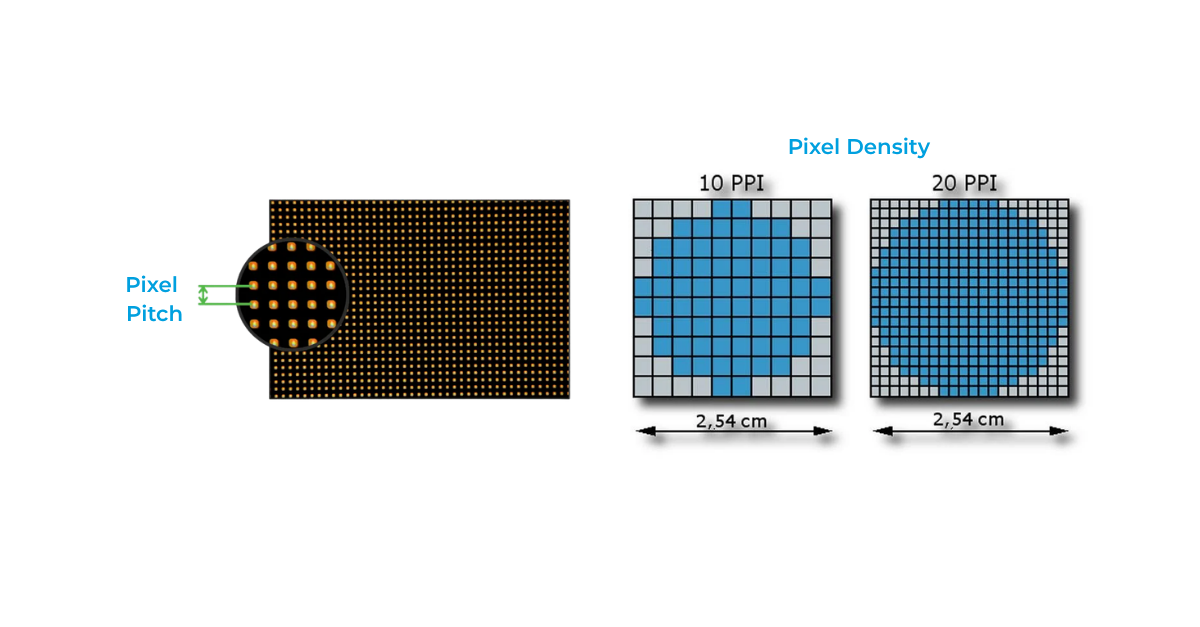
Before going further, it’s worth clarifying the difference between pixel pitch and pixel density, as the two terms are often confused. Pixel pitch refers to the distance between the centre of one LED pixel and the next, measured in millimetres. A smaller pixel pitch means the pixels are packed closer together, resulting in a sharper and more detailed image at closer viewing distances.
Pixel density describes how many pixels are packed into a specific area of the display, usually measured in pixels per square metre or pixels per inch. Higher pixel density means greater image detail and smoother visuals. The two are directly linked. As pixel pitch decreases, pixel density increases. In simple terms, a finer pitch creates a higher-resolution display. Pixel density was and still is a key consideration for projection projects.
The Viewing Distance Reality Check for LED Screens
Pixel pitch only matters relative to how close people get. A simple rule of thumb that keeps cropping up across manufacturer guides and install specs is that minimum comfortable viewing distance in metres is roughly equal to the pitch in millimetres (with some variation depending on who you ask – 1× to 1.5× is common). So a 4 mm pitch works fine from 4–6 m away, a 6 mm pitch from 6–9 m, and so on.
In most immersive attractions the audience isn’t nose-to-wall. People move through spaces, stand back, experience the environment as a whole. Whilst the human eye has massive total field of view (FOV) of about 200 to 220 degrees horizontally and 135 to 150 degrees vertically, observed human behaviour in immersive space shows that people move to the middle of the space to fully absorb the environment around them.
Unless you are using touch interactivity, there are very few applications where a viewer needs or wants to stand extremely close to the display surface, particularly on massive immersive displays. So, why do we often see sub-1.8mm pixel pitches used and does it really make a huge difference to image quality?
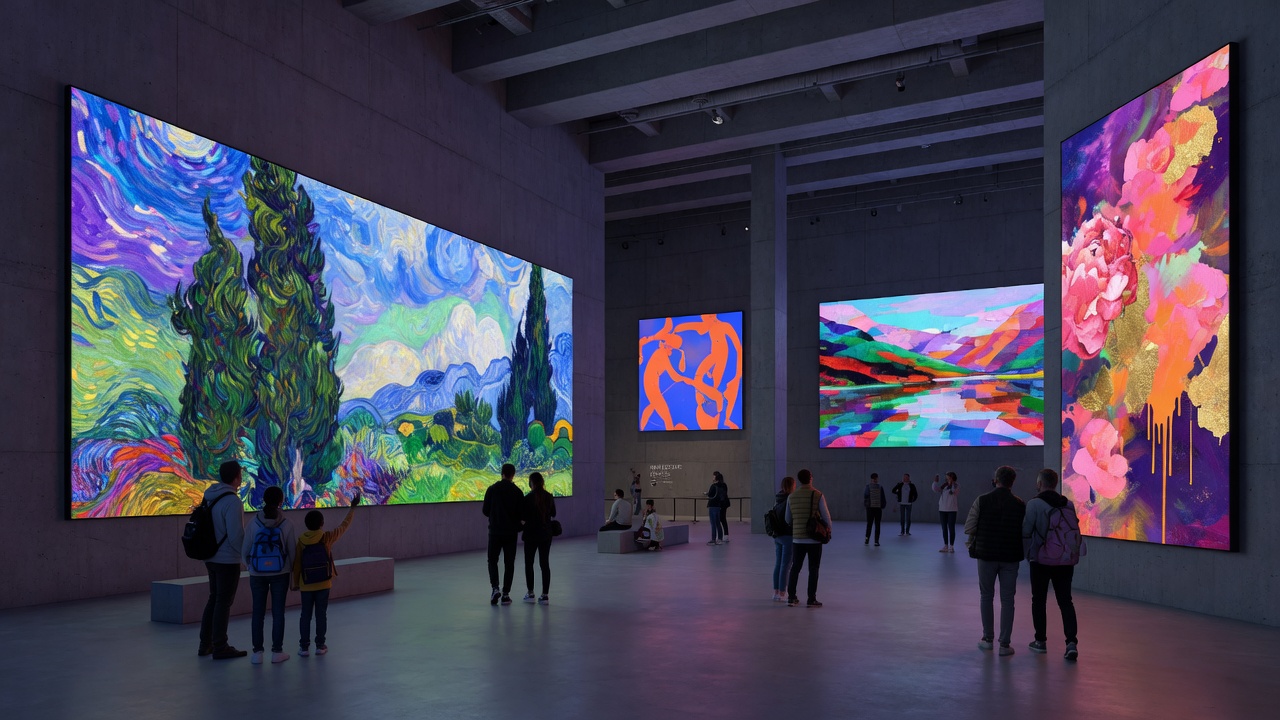
This might be one immersive application example where viewers will get up close and personal.
Why Finer Pixel Pitch Isn’t Automatically Better
LED manufacturers have made huge strides, and the ability to customise pitch is genuinely useful in the right places. But chasing the tightest possible pitch in a large immersive space often delivers diminishing returns at best – and some genuine downsides at worst. Here are the practical costs that too many specs overlook:
-
Reduced contrast – Finer pitches can introduce subtle uniformity and black-level challenges in real-world conditions. The denser the array, the harder it becomes to maintain deep blacks, as the faces of the pixels are not completely black. Wider-pitch designs can actually deliver better contrast thanks to the greater amount of high-contrast material between pixels. And good contrast has a massive effect on image quality. When it comes to image quality, it is one of the most important specs to consider, so we strongly recommend you ask for shoot-outs – don’t just trust the specs.
-
Increased running costs – More pixels per square metre means more LEDs, more driver circuitry and higher power draw. Real-world figures show finer-pitch (average of <1.9mm across 20 manufacturers) panels often sit in the 180–370 W/m² range under typical content, versus 100–225 W/m² for wider pitches (average for >1.9mm across 20 manufacturers).
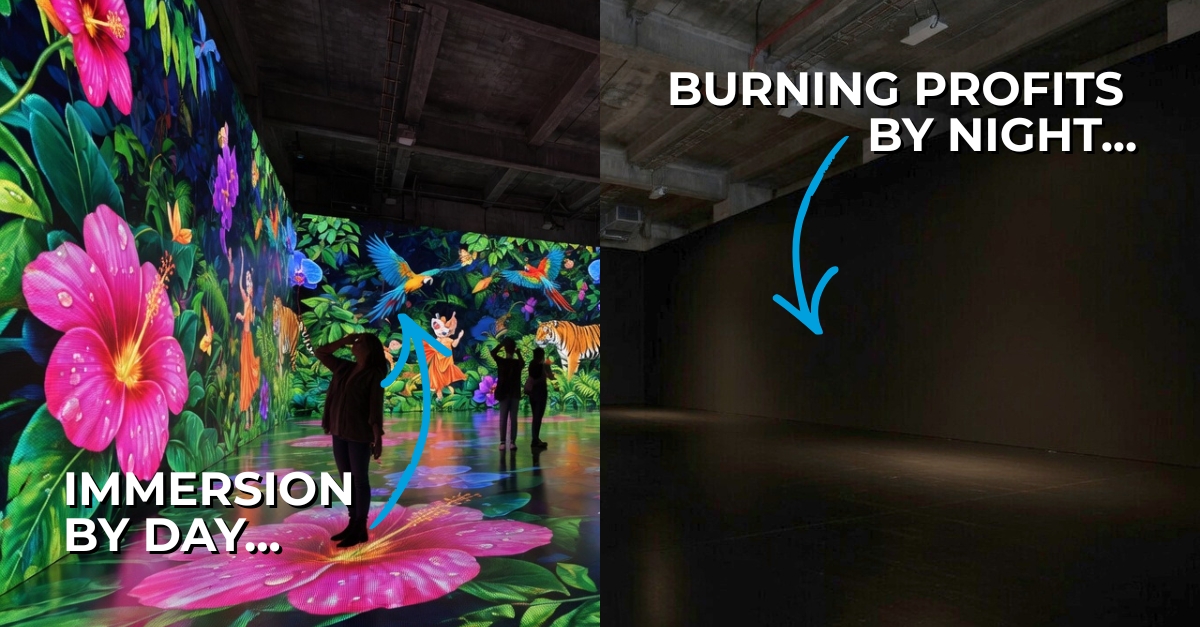
Over a 200 m² wall running 12–14 hours a day, that adds up fast on the electricity bill.🍃 Looking for a more sustainable immersive venue? If you want to make even further savings you should explore ZEUS – our patented, energy saving solution that cuts LED screen standby waste to ZERO and can save you tens of thousands of dollars a year whilst significant reducing your carbon emissions.
-
Increased heat output – Higher pixel density equals more heat. That means beefier cooling systems, higher HVAC loads and potentially noisier environments – none of which you want inside an immersive experience where audio and atmosphere matter. Extra heat also shortens component life and can affect colour stability over time.
-
Increased content creation costs – Once you commit to ultra-high resolution, every asset has to match. Render times go up, file sizes balloon, and the creative team needs higher-end workstations and more detailed source material. For interactive or real-time experiences the difference in compute demand can be substantial.
-
Increased content playback and management costs – More pixels demand more powerful media servers, higher bandwidth, greater storage and more complex synchronisation across the wall. Redundancy and failover become pricier too. A system that could have run on a couple of solid servers suddenly needs a rack of high-spec processing – another line item that’s easy to underestimate at the spec stage.
LED screen for immersive space – When More Pixels Actually Hurt Playback Quality
It’s worth adding an important caveat here. Yes, finer pixel pitch delivers higher native resolution – and in theory that should always produce a better image. In practice, especially in large-scale immersive attractions, this advantage is often illusory. Massive LED screen surfaces with tight pitches can easily reach native resolutions of 10K, 12K or higher across wide or curved canvases. Yet the vast majority of video content, CGI renders and motion graphics for attractions are mastered in standard 4K, 6K or at most 8K workflows.
Very few projects have the budget or time to produce true pixel-for-pixel assets at the wall’s enormous native resolution.
The result? Media servers and processors are forced to upscale or interpolate content heavily to fill the display. This process can introduce softening, minor artefacts and a final image that is actually less crisp than if the screen’s native resolution had been more closely matched to the delivered content. Professionals in the field strongly recommend creating content at (or very close to) the display’s native resolution to achieve maximum sharpness and avoid scaling issues – sometimes the massive resolution of the screens makes this tricky to do well.
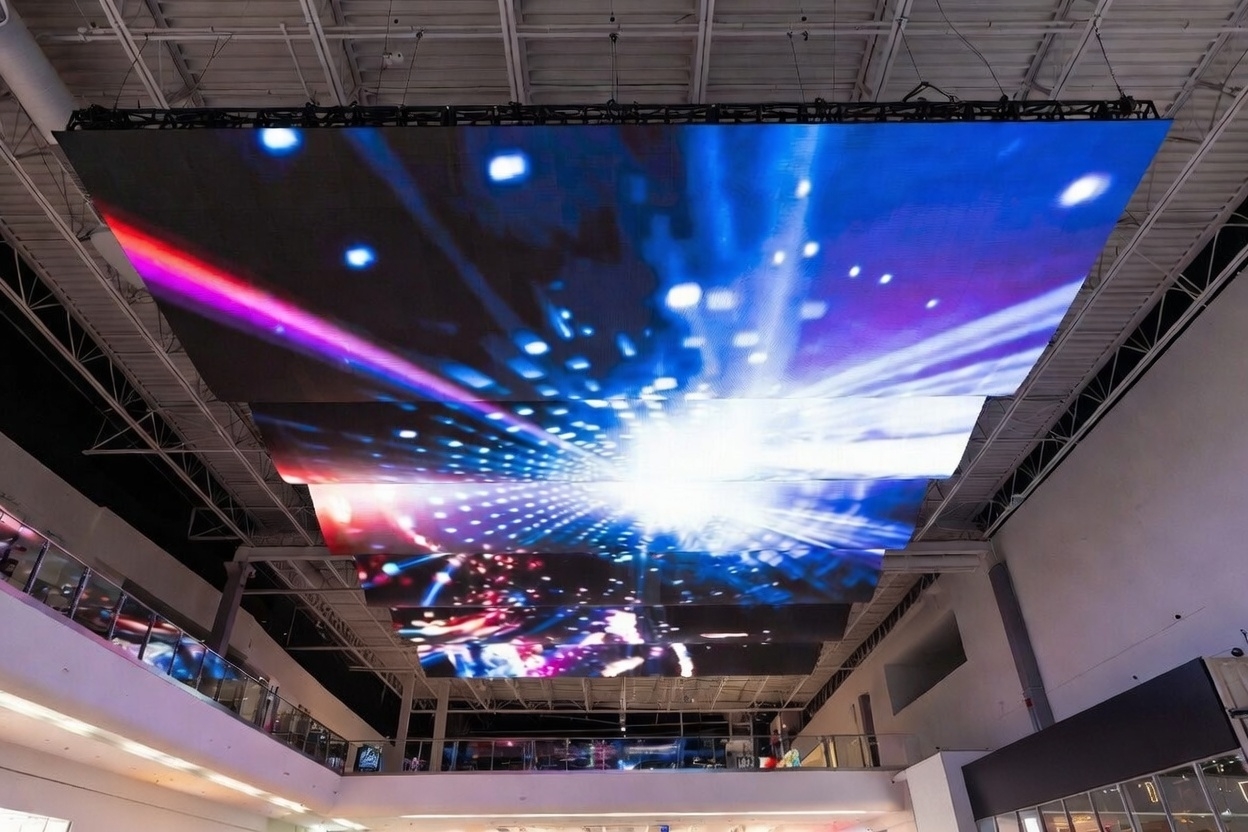
Choosing a pixel pitch whose native resolution better aligns with real-world content deliverables often produces a perceptually sharper, cleaner result – while simultaneously cutting power consumption, heat, contrast challenges and overall system cost. Counter-intuitively, a wider pixel pitch that allows near 1:1 pixel mapping can deliver visibly better playback quality than an ultra-fine display that leaves the screen/ content under-optimised.
The Smarter Way Forward – Work with a Trusted LED Screen Partner
The phrase “don’t pay for LED screen pixels you don’t need” isn’t about cutting corners. It’s about engineering value. If anything, we make less money!
Spend client budget where it actually improves the guest experience – higher contrast, pixel encapsulation for increased durability, higher quality internal for better reliability, better ICs for grayscale & better colour – rather than on extra resolution that nobody will ever see from the intended distance, or on pixels that end up wasted because the content can’t keep up.
At digiLED we see this every day on projects and work hard to help educate and guide decision makers to make informed choices. Our approach has always been to match the technology to the space: bespoke panel sizes, curves and pitches that make sense rather than defaulting to the tightest available. Technologies like digiLED ZEUS® help keep running costs and carbon impact under control precisely because we’re not wasting energy on unnecessary density. The result is a display that looks spectacular, behaves reliably for years, and doesn’t leave operators paying for performance they’ll never use.
Next Steps for Specifying LED Screens in Immersive Attractions
Next time you’re specifying for a large immersive attraction, take a step back and ask the simple question: from where the audience will actually stand, and with the content we can realistically produce, will those extra pixels make any difference at all? If the honest answer is no, you’ve just found yourself a smarter, more sustainable spec – and probably a happier client too.